
Language
Views: 0 Author: Site Editor Publish Time: 2026-03-17 Origin: Site


You use neodymium magnets when you need strong force. UH Grade neodymium magnets are special. They stay strong even when it is hot. The table below shows how UH Grade magnets work at higher temperatures than standard grades:
| Grade | Maximum Operating Temperature |
|---|---|
| UH | 180°C (356°F) |
| Standard | Up to 80°C (176°F) |
You can trust UH Grade magnets for tough jobs. These jobs need both strength and heat resistance. Knowing the grade helps you choose the right magnet for your needs.
UH Grade neodymium magnets work in heat up to 180°C (356°F). This makes them good for places with high heat.
Knowing the grading system helps you pick the right magnet. Higher grades mean the magnet is stronger and can handle more heat.
Always look at both the grade number and letter when you choose a magnet. This helps make sure the magnet fits your project.
Use UH Grade magnets in motors, generators, and machines that need strength and heat resistance. This gives the best performance.
Be careful with UH Grade magnets. Wear gloves, store them safely, and keep them dry. This stops rust and damage.
You may notice that neodymium magnet grades use letters and numbers. These grades help you understand how each magnet performs, especially in heat. The grading system uses letters like N, SH, UH, and EH. Each letter stands for a different level of temperature resistance. The table below shows how these grades compare:
| Grade | Description | Temperature Resistance |
|---|---|---|
| N | Neodymium | Standard up to 80°C |
| SH | Super High | Higher than 80°C |
| UH | Ultra High | Higher than SH range |
| EH | Extreme High | Highest temperature range |
You can see that as you move from N to EH, the magnets can handle more heat. The number in the grade, like N35 or N42, tells you about the magnetic strength. The letter tells you about the temperature resistance. This system helps you pick the right neodymium magnet grades for your needs.
UH grade stands for "Ultra High" temperature resistance. You should choose UH when you need magnets that work in hot places. For example, UH grade neodymium magnets can handle up to 180°C (356°F). SH grade magnets work up to 150°C (302°F), and EH grade magnets go even higher, up to 200°C (392°F).
Here is a chart that shows the maximum operating temperatures for SH, UH, and EH grades:
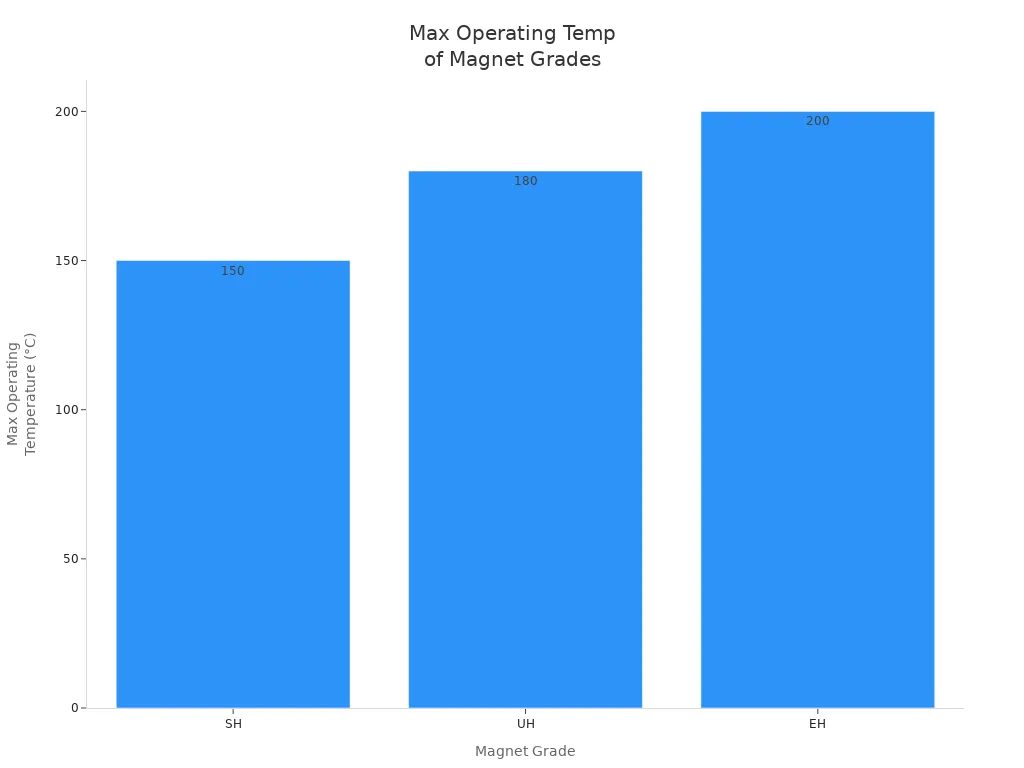
You can see that UH grade sits between SH and EH. UH grade neodymium magnets also have strong magnetic power. They often show higher remanence than SH grade. You should use UH grade when you need both strength and heat resistance. This makes them a smart choice for motors, turbines, and other high-performance machines.
Tip: Always check both the grade number and the letter when you select neodymium magnet grades. This helps you match the magnet to your project’s needs.

Image Source: unsplash
It is important to know how UH grade neodymium magnets handle heat. These magnets can work in places where it gets very hot. The table below shows the difference:
| Magnet Type | Max Operating Temperature (°C) |
|---|---|
| Standard Neodymium | 80 |
| UH Grade Neodymium | 180 |
UH grade magnets can work up to 180°C (356°F). This means you can use them in machines or devices that get much hotter than what standard neodymium can handle. If you use a magnet in a hot place, you want to make sure it does not lose its power. When the temperature stays under the maximum, the magnet might get a little weaker, but it will get strong again when it cools down. If the temperature goes over the limit, the magnet will lose its strength forever.
Note: Always check the highest temperature a magnet can handle before using it in a hot place.
UH grade neodymium magnets are very strong. You can see how strong they are by looking at their residual induction, which is measured in Tesla (T). A bigger number means a stronger magnet. Here is a table that shows how strong different UH grades are:
| Grade | Residual Induction (Br) |
|---|---|
| N28UH | 1.04-1.08 T |
| N30UH | 1.08-1.13 T |
| N33UH | 1.13-1.17 T |
| N35UH | 1.17-1.22 T |
| N38UH | 1.22-1.25 T |
| N40UH | 1.25-1.28 T |
| N42UH | 1.28-1.32 T |
| N45UH | 1.32-1.38 T |
| N48UH | 1.37-1.43 T |
| N50UH | 1.40-1.45 T |
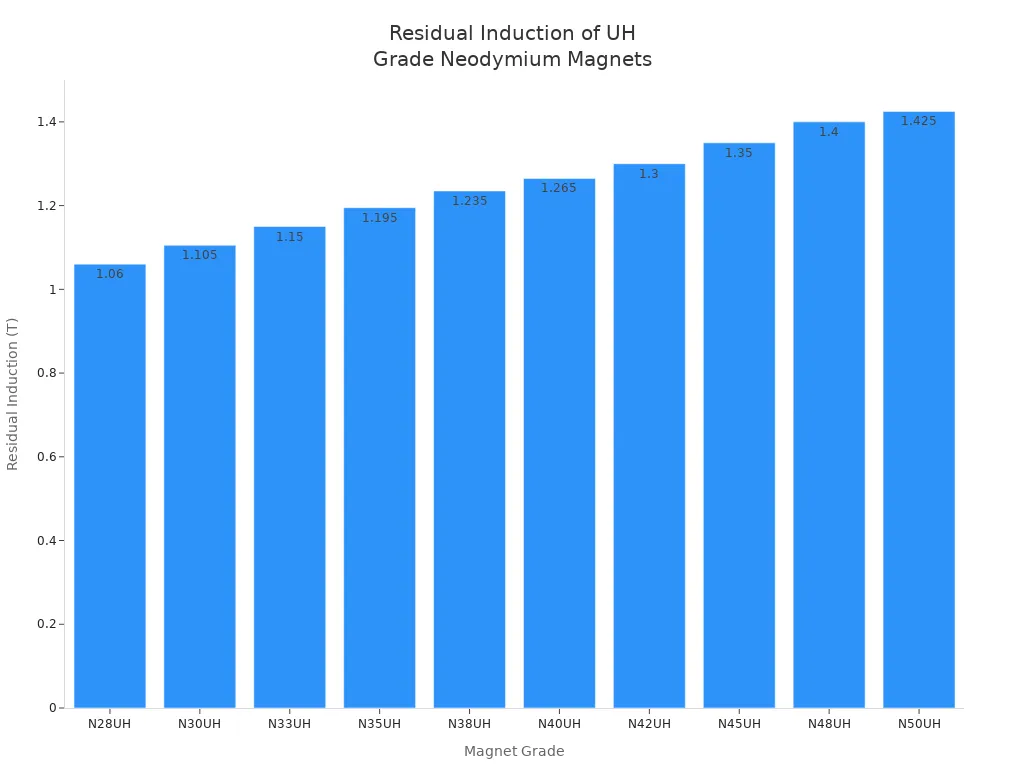
When you use these magnets in hot places, they might get a little weaker. This is called a reversible loss. The magnet gets weaker as it gets hotter, but it gets strong again when it cools down. If you heat the magnet above its maximum temperature, it will lose its strength forever. For example:
If the temperature goes up but stays under the limit, the magnet only gets weaker for a short time.
If the temperature goes over 180°C, the magnet loses its power and cannot get it back.
You should always keep the magnet under its maximum temperature so it stays strong.
UH grade neodymium magnets have high coercivity. This means they do not lose their magnetism easily, even when things get hot or tough. You want high coercivity if you need a magnet to keep working in hard places. Here are some important points:
UH grade magnets have higher coercivity than lower grades.
High coercivity helps the magnet stay strong in hot or rough places.
This makes UH grade magnets a good choice for motors, generators, and other machines that get hot or shake a lot.
Tip: High coercivity means your magnet will last longer and stay strong, even when things get tough.

Neodymium magnets are used in many factories. They help machines work better and last longer. Here are some ways they are used:
Motors and generators need strong magnets to work well in small spaces.
Servo motors and spindle drives in CNC machines use these magnets for exact movement.
Robots and automation systems use them for quick and accurate actions.
Magnetic separators take out metal from food, plastic, and medicine.
Magnetic chucks and holding systems keep parts safe during cutting.
Magnetic fasteners hold doors, panels, and containers in place.
Industries pick UH grade magnets when they need both strength and heat resistance.
Neodymium magnets are important in electronics and small devices. They help audio equipment and data storage work better. Some main uses are:
Speakers, headphones, and microphones use these magnets to make sound clearer and stronger.
Hard disk drives use them for moving read and write heads exactly.
Vibration motors in phones and wearables use small UH grade magnets for good feedback.
These magnets help make devices lighter, thinner, and use less energy.
You get better sound, faster data, and smaller gadgets because of these magnets.
UH grade neodymium magnets work well in hot places. You see them in:
Factories and engineering, like motors, pumps, and welding tools.
Car parts such as alternators and electric motors.
Medical devices, like MRI machines and surgical tools.
Aerospace and defense, where magnets must work in tough conditions.
Renewable energy, like wind turbines and solar panels.
These jobs need magnets with high Br, Hci, and BHmax values. For example, Neo3525 is a UH grade magnet that works up to 180°C. You can count on these magnets to keep working when others stop.
Tip: Always pick the right magnet grade for your job’s heat and strength needs to get the best results.
UH magnet grade gives you many good things. These magnets stay strong even when it is hot. You can use them in motors, pumps, and sensors. They help machines work better and last longer. You will notice machines are more efficient and reliable. The table below shows how UH magnet grade helps in different jobs:
| Application Area | Benefit | Efficiency Improvement |
|---|---|---|
| Industrial and automotive | Keeps working up to 260°C, so it works well in hot places. | Makes products smaller and lighter, which saves energy. |
| Motors, generators, pumps, sensors | Great for jobs with high heat, so machines do not break. | Uses less energy to do the same work. |
| New energy vehicles, intelligent robots | Works well in tough jobs, so people use it for new ideas. | Makes machines run better and use less power. |
UH magnet grade is special because it is strong and can handle heat. You can count on these magnets when others stop working.
You should know the problems before picking a magnet grade. UH magnet grade costs more than other magnets. These magnets are easy to break or chip if dropped. They need a coating to stop rust. Here are the main problems:
| Disadvantages |
|---|
| * Easy to break or chip * Can lose power in high heat * Needs a coating to stop rust * Costs more than other magnets |
UH magnet grade can lose strength if it gets too hot. Water can make it rust and break. If you drop it, it can crack. You must be careful with these magnets.
Temperature: Magnets can lose power if they get too hot.
Humidity: Water can cause rust and make magnets weaker.
Impact: If you hit or drop them, they can crack.
You need to be safe when using and storing UH magnet grade. These magnets are strong and can pinch your skin. Always wear gloves and safety glasses. Keep magnets away from electronics and things that can break. Store them in boxes that are not magnetic, in a dry and cool place. Do not drop or hit the magnets. Use tools that are not magnetic to pull them apart. Only handle one magnet at a time. Teach kids and coworkers how to use magnets safely. If someone swallows a magnet, get help right away.
Wear gloves and safety glasses to protect yourself.
Keep magnets away from electronics and breakable things.
Store magnets in dry, cool boxes that are not magnetic.
Do not drop or hit magnets so they do not break.
Use non-magnetic tools to separate magnets.
Handle one magnet at a time to avoid pinching.
Teach others how to use magnets safely.
Get help fast if someone swallows a magnet.
If you keep magnets in a dry, cool place under 40°C, you stop rust and damage. Put spacers between magnets and use boxes that are not magnetic. If magnets get too hot, they can lose their power forever. Dropping or hitting magnets can break them. Water can make magnets rust and get weak.
Tip: You keep your magnet grade strong and safe by following these steps.
You need to look at several factors before you pick a UH grade magnet for your project. Each application has its own needs. The table below helps you see what to check:
| Factor | Description |
|---|---|
| Temperature Stability | Choose the right grade for the heat level in your project. |
| Corrosion Resistance | Pick coatings like nickel or epoxy for wet or harsh places. |
| Demagnetization Resistance | Make sure the magnet keeps its strength over time. |
| Application-Specific Needs | Think about what your project really needs from the magnet. |
You should also ask yourself these questions:
What magnetic strength do you need?
What is the highest temperature the magnet will face?
Does your magnet need to resist demagnetization?
What size and shape fit your design?
Will the magnet face water or chemicals?
Do you need to meet any safety rules?
For example, motors and generators need high coercivity and thermal stability. Sensors need a magnet that works the same way every time. Holding systems need a magnet with a strong pull force and high maximum energy product.
When you choose a UH grade magnet, you want to match it to your job. Here are some tips:
Check the grade and magnetic strength. UH grades work up to 180°C. Use the chart below to compare grades:
Pick the right size and shape. Discs, blocks, and rings all work for different jobs.
Make sure the magnet can handle the heat. If it gets too hot, it can lose its maximum energy product.
Choose a coating for extra protection. Nickel and epoxy coatings help the magnet last longer.
Think about how the poles are set up. The right pole direction gives you the best results.
You will find that automotive engines, aerospace systems, and industrial machinery often use UH grade magnets for their high maximum energy product and heat resistance.
You want to make sure your magnet is high quality. Look for these certifications:
| Certification | Description |
|---|---|
| ISO 9001 | Checks that the company uses good quality control in making magnets. |
| IATF 16949 | Needed for car parts, showing the magnet meets auto industry rules. |
| ISO 13485 | Needed for medical devices, showing the magnet is safe for health use. |
Always ask for test reports and certificates from your supplier. This helps you trust that your magnet will work well and last a long time.
Tip: A good supplier will show you proof of quality and help you pick the right magnet for your needs.
UH Grade neodymium magnets stay strong in hot places. You can use them in electric motors and generators. Other magnets might stop working in these jobs. Always pick the right magnet grade for your project. The table below shows which grades work for different things:
| Magnet Grade | Temperature Resistance | Application Example |
|---|---|---|
| H | High | Robotics |
| SH | Higher than H | Automotive |
| N35 | Standard | General use |
Be careful and follow safety rules to get the best results.
UH grade means "Ultra High" temperature resistance. You can use these magnets in places that reach up to 180°C. They stay strong when other magnets lose power.
You should keep magnets in a dry, cool box. Use spacers between magnets. Store them away from electronics. Wear gloves when you handle them.
Yes, UH grade magnets can rust. You need to pick magnets with a nickel or epoxy coating. This protects them from moisture and keeps them strong.
You find UH grade magnets in motors, generators, sensors, and medical devices. They work well in hot places like factories, cars, and wind turbines.
No, UH grade magnets are not safe for kids. They are very strong and can pinch skin. If swallowed, they can cause serious harm. Always keep them out of reach.


