
Language
Views: 0 Author: Site Editor Publish Time: 2026-01-16 Origin: Site


A halbach array is a special way to arrange permanent magnets. Scientists made this setup to make the magnetic field much stronger on one side. The field almost goes away on the other side. This happens because the halbach magnets follow a pattern that turns their direction in space. Many industries use halbach technology to make machines better, save energy, and make places safer. Companies like TAIXIONG help bring advanced magnetic solutions to factories, cars, and electronic devices.
A Halbach array puts magnets in a special order. This makes a strong magnetic field on one side. The other side has a weak field. This design helps in many ways.
Engineers can change how Halbach arrays work. They do this by moving the magnets around. Different patterns can make the array more sensitive. They can also make the field stronger or weaker.
Halbach arrays are used in many fields. These include transportation, medical imaging, and energy systems. They help things work better and use less energy.
TAIXIONG makes custom Halbach arrays. They give advanced magnetic solutions for different needs. They make sure their products are safe and high quality.
Learning about Halbach arrays helps engineers. It lets them build better machines. It also helps save energy and get the right magnetic effects.
Image Source: unsplash
A halbach array is a special way to put magnets together. Each magnet faces a different direction in the group. The magnets turn at right angles to each other in a set order. This setup makes the magnetic fields join on one side. On the other side, the fields cancel each other out. So, one side has a strong magnetic field. The other side has a very weak field.
Klaus Halbach came up with this idea. He worked at Lawrence Berkeley National Laboratory. He learned that putting magnets in a certain pattern made one side much stronger. This finding helped create new technology. It is used in places that need strong and focused magnetic fields.
| Key Point | Description |
|---|---|
| Inventor | Klaus Halbach made the halbach array during his research. |
| Discovery | He saw that a special magnet pattern makes a stronger field on one side. |
| Applications | Early uses were maglev trains and magnetic bearings. |
The halbach array uses permanent magnets. How the magnets are placed is very important. The setup makes the field stronger where it is needed. This design means less extra shielding is needed. Many industries use halbach arrays in magnetic levitation, magnetic bearings, and particle accelerators.
A halbach array works in a different way than regular magnets. Regular magnets have about the same field on both sides. The strength does not change much from one side to the other. But a halbach array puts the field on just one side. The other side has a much weaker field or almost none.
The big difference is how the magnets are lined up. In a halbach array, the magnets are in a pattern. This makes the fields add up on one side and cancel on the other. The result is a stronger and more focused field where it is needed. Regular magnets do not have this pattern. Their fields spread out the same on both sides.
Halbach arrays can also give higher sensitivity and stronger signals than regular magnets. For example, they can make strong signals even from far away. This helps in sensors and other devices. The shape and size of the array can change how the field acts. Engineers can change the design for different jobs.
Note: The halbach array lets engineers choose between sensitivity and range. By changing the shape, they can control how far and how strong the field goes.
Image Source: unsplash
The halbach array uses a special way to arrange magnets. This arrangement changes how the magnetic field acts. Each magnet in the group points in a different direction. The pattern of these directions is very important. When people build a halbach array, they can use different patterns to get the effect they want.
The 4-pattern circular arrangement uses four magnets. Each one turns 90 degrees from the last. This setup makes the magnetic field much stronger on one side.
The 8-pattern circular arrangement has eight magnets. Each one turns 45 degrees from the next. This pattern gives a smoother and more even field.
The all-inward arrangement points all magnets toward the center. This creates a strong unidirectional field on one side.
The unidirectional arrangement lines up all magnets in the same direction. This makes the field focus in one direction.
These patterns help the halbach array create a strong magnetic field where it is needed. The way the magnets turn and face each other changes how the field looks and acts. People can pick the best pattern for their machines or devices.
The halbach array works by changing the direction of each magnet’s force. This change happens in a line or a circle. The field gets stronger on one side and weaker on the other. This happens because the magnets add their force together on one side. On the other side, the forces cancel each other out.
The halbach array uses a special trick called spatially rotating magnetization. This means the direction of the magnets changes step by step across the array. The result is a strong magnetic field on one side. The other side has almost no field. This effect helps in many machines that need a focused field.
People have tested how strong the field is in a halbach array. They compared it to other ways of lining up magnets. The table below shows the pull force for different setups:
| Magnet Configuration | Pull Force (lb) |
|---|---|
| Halbach Array | 72 |
| North Poles Up | 77 |
| Alternating Pattern | 88 |
| Mounting Magnet | 84 |
The chart below shows these results in a simple way:
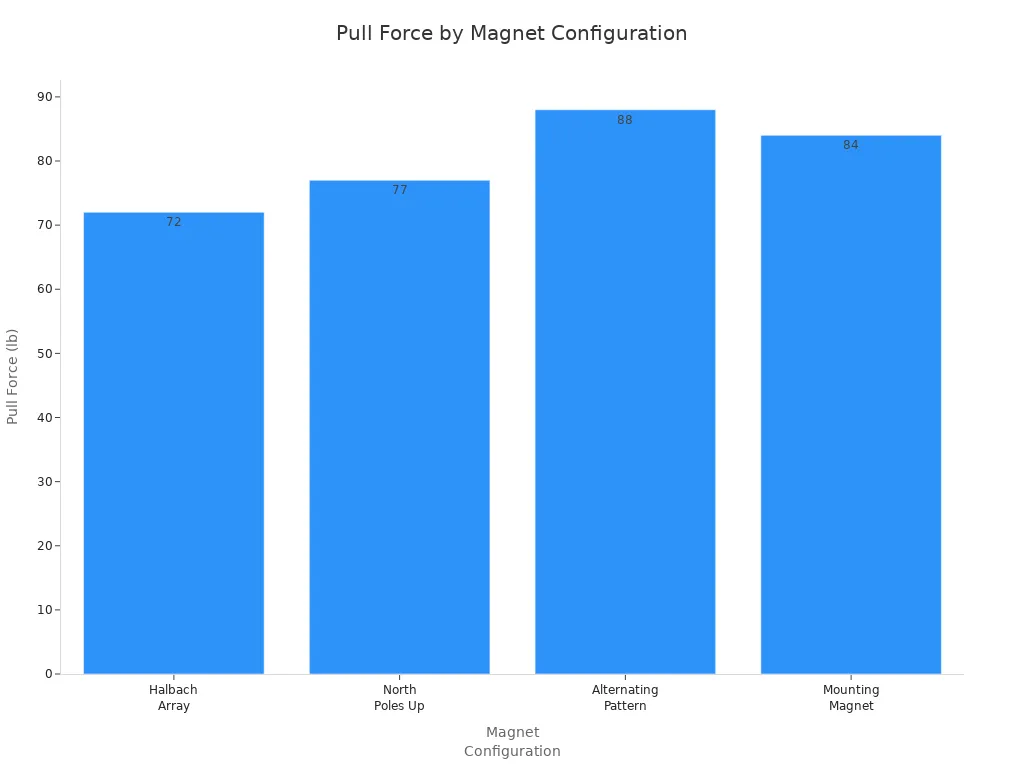
The halbach array does not always have the highest pull force, but it gives a strong magnetic field on one side. This makes it useful for many jobs. The special pattern helps focus the field where it is needed most. People use this effect in machines, sensors, and even trains.
Tip: The halbach array can help engineers control where the strong magnetic field goes. By changing the pattern, they can make the field stronger or weaker on each side.
The halbach array shows how smart design can change the way magnets work. This idea helps many industries get better results from their magnetic equipment.
Halbach arrays have different shapes for different jobs. The two main types are linear Halbach arrays and cylindrical Halbach arrays. Each type looks different and is used for special reasons.
| Type | Description | Applications |
|---|---|---|
| Linear Halbach Array | Magnets are in a straight line. This works well for flat things. | Transport systems, conveyor belts |
| Cylindrical Halbach Array | Magnets are in a circle. This is good for things that spin. | Electric generators, motors |
A linear Halbach array has magnets in a row. Each magnet points a different way in a set order. This makes one side have a strong field. The other side has a weak field. Linear Halbach arrays are good for flat places and things that move.
Many companies use linear Halbach arrays. Some examples are:
Medical devices
Research equipment
Tools that need strong holding or pulling
Linear Halbach arrays help control where the field goes and how strong it is. They also cut down on extra fields. This makes them safer and work better.
| Feature | Linear Halbach Arrays |
|---|---|
| Structure | Magnets in a straight line |
| Magnetic Field Direction | Strong in one way, makes flat beams |
| Applications | Magnetic conveyor systems, sensors, undulators |
| Performance | Easy to use on flat places |
| Stray Field Management | Cuts down on extra magnetic fields |
A cylindrical Halbach array puts magnets in a circle. The magnets can be shaped like squares or trapezoids. This setup makes a spinning field inside the circle. The field is very strong inside. Outside, the field is almost gone. The way the magnets turn helps make the field even and strong.
Engineers use cylindrical Halbach arrays in many cool machines. These include:
| Application Type | Description |
|---|---|
| Brushless Motors | Use many poles for strong turning power. |
| Magnetic Couplings | Move power through walls, good for closed systems. |
| High-field Cylinders | Make the field better in electromagnetic systems. |
| Particle Accelerators | Focus fields to control particles. |
| Medical Applications | Used in MRI and NMR machines for pictures of the body. |
| Magnetic Levitation | Help things float in trains and machines. |
| Energy Harvesting | Make energy change work better. |
| Magnetic Refrigeration | Use magnets to help cool things. |
| Aeronautics | Make planes and rockets work better. |
The cylindrical Halbach array is great at making a strong and even field inside the circle. This helps in motors, medical machines, and energy systems.
A halbach array makes magnets work much better. This setup gives a strong field on one side and a weak field on the other. Engineers like halbach arrays because they have high field strength and the field stays even. Some important improvements are:
The B0 field strength in a halbach array is about 30 mT.
The field stays even, with inhomogeneity around 1500 ppm.
A special SmCo halbach array can make inhomogeneity about 1200 ppm.
New designs help keep the field steady when temperatures change.
Halbach arrays help polish and finish surfaces. They use fewer magnets to make a strong field. This makes surfaces smoother, sometimes less than 1 nanometer rough. These results show why halbach arrays are useful for many magnetic jobs.
TAIXIONG makes advanced magnetic products. The company builds custom neodymium segment halbach arrays for motors. These arrays come in 1 Tesla and 2 Tesla N52 Grade choices. TAIXIONG lets people order small amounts, which helps with testing and special projects. Their products are safe and high quality. TAIXIONG has patents for magnetic tools and safety certificates like RoHS, CE, and ISO. The company always works to make magnets better for hard jobs.
Many industries use halbach arrays to get better results. The table below lists some top uses:
| Application Type | Description |
|---|---|
| Maglev Technology | Used in Maglev trains for fast, quiet travel, like the Shanghai Maglev Train at 431 km/h. |
| Particle Accelerators | Focuses and steers beams in places like CERN’s Large Hadron Collider. |
| Electric Motors and Generators | Improves power and efficiency in motors and generators. |
| Magnetic Separators | Makes it easier to separate metals in factories. |
Halbach arrays help trains float and move smoothly in magnetic levitation systems. Factories use these arrays in magnetic separators to sort things. TAIXIONG’s skill with halbach arrays helps transportation, energy, and manufacturing industries. The company works hard to make new, safe, and efficient products so customers can reach their goals.
Making a halbach array is not easy for engineers. They need to line up each magnet very carefully. If they make a small mistake, the magnetic field can change. The job needs special tools and good planning. Some main problems are:
The steps to build it are hard and need each magnet in the right spot.
It costs a lot because special machines and skilled people are needed.
Magnets can get weaker if the temperature changes.
Magnets push away from each other, so putting them together is tough and sometimes dangerous.
Small arrays need extra care because tiny parts are hard to work with.
New ways help make building easier. For example, some engineers use beads to hold magnets while putting them together. This trick helps the magnets fit better and tighter. New magnet technology also tries to save energy and make building faster, but these ideas are still being tested.
Tip: Using new tools and being careful can help stop mistakes and make halbach arrays better.
Halbach arrays have another problem called demagnetization. This happens when the magnetic field inside the magnets gets too low. It can happen if the magnets get overloaded for a short time. Most of the time, a well-made halbach array keeps the magnetic field strong enough. This means the chance of losing magnet power is low if the array is built right.
Engineers pick smart designs and materials to make the risk even lower. The table below shows some ways to keep magnets safe from demagnetization:
| Design Strategy/Material | Description |
|---|---|
| High magnetic flux density | Needed in important spots for best results. |
| Low magnetic flux density | Used in other places to stop bad effects. |
| Homogeneous field distribution | Keeps the field even everywhere in the array. |
| Maximized air gap volume | Makes the array work better. |
| Magnetocaloric materials | Good for cooling systems that use magnets. |
| Low-cost material replacement | Saves money by using cheaper magnets in some spots. |
| Soft magnetic materials | Helps control the field in some areas. |
| Air or Teflon | Cuts down on magnetic problems in special cases. |
By picking the right materials and design, engineers can make halbach arrays safer and work better for many uses.
Recent studies show the halbach array makes magnetic fields stronger and more even. These changes help many things like medical imaging and energy systems. People use halbach arrays in maglev trains, electric motors, MRI machines, particle accelerators, and magnetic bearings.
Maglev trains float above tracks with special magnetic lift.
Electric motors work better because the field is focused.
MRI machines use strong magnets to get clear pictures.
Particle accelerators move particles exactly where they need to go.
Magnetic bearings help parts move without touching each other.
TAIXIONG is a trusted supplier. They have ISO 9001 certification. They offer custom magnets and separators for different needs.
| Supplier Name | Certifications | Customization Offerings |
|---|---|---|
| Shanghai Taixiong Magnetic Industrial Co., Ltd. | ISO 9001 | Custom magnets and lifters made from drawings. |
New ideas like 3D printed shapes and tiny arrays will change the future. TAIXIONG gives expert help and new solutions for every project.
A Halbach array has a strong field on one side. The other side has a weak field. This setup lets engineers put magnetic power where they need it most.
People use Halbach arrays in maglev trains and electric motors. They are also in magnetic separators and medical machines. These arrays help things go faster, stay safer, and use less energy.
Yes. Halbach arrays cut down on wasted magnetic fields. This design helps machines use less power and work better.
TAIXIONG makes custom Halbach arrays for customers. The company helps people pick the right magnets for their needs. TAIXIONG gives advanced magnetic solutions to many industries.


